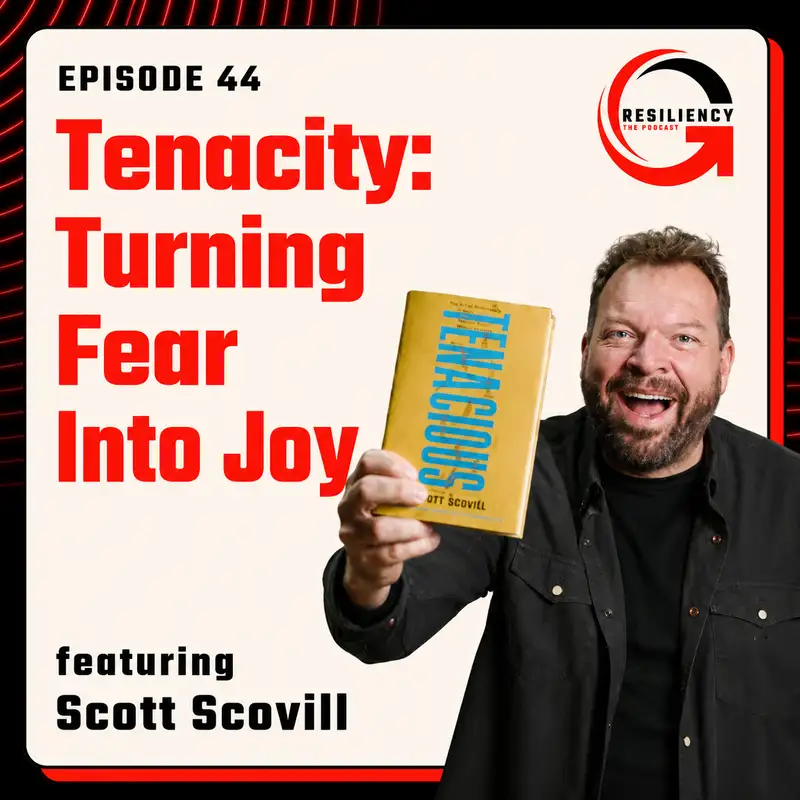
Tenacity: Turning Fear into Joy ft. Scott Scovill
Jenn Quader (00:05)
Welcome to Resiliency the Podcast. Today's guest started his career by talking his way into a gig as a roadie for the band U2 on their Joshua Tree tour. Now that one gutsy move turned into working with other musicians like the Rolling Stones, David Bowie, Whitney Houston, and Ozzie Osborne.
this led him to directing and producing music videos for the likes of Alan Jackson, Brad Paisley, and Tim McGraw, and producing live shows for which he won a Country Music Award.
He now owns multiple companies in the Nashville area and he centers around the entertainment industry. And beyond that, he's really a true modern day Renaissance man. You're gonna hear from him today about all sorts of things, but he's an entrepreneur, a producer, a director, a musician, an author, and a relentless dream chaser. We're so excited to have his energy. And then did I mention that he's a touring musician who's gonna be opening for Brad Paisley in a couple weeks? Yeah, we're we're all having a fan moment over here.
His story is not just about all this amazing success in the music industry, it's really about the mindset behind what it takes to keep trying when fear, failure, grief, and uncertainty threaten to stop you. In his new book called Tenacious: The Art of Relentlessly Pursuing Your Wildest Dreams, our guest shares how he went from being a young man who was really paralyzed by a fear of failure.
To someone who has built a life defined by courage, creativity, and persistence. He writes that tenacity changed everything for him, and that it's something that each of us can develop. We are honored, we are excited, we might have to have him do some music for us, but we can't wait to hear more from the wonderful Scott Scovill Welcome to Resiliency the Podcast.
Scott Scovill (01:50)
Welcome. Welcome indeed. ⁓ that was a really nice intro. Thank you. And it's great to be here. Great to be here.
Kelly Culver (01:58)
Scott, we're thrilled that you could join us today. and and yeah, Jenn always does a really great intro, just sets everybody up for a fabulous discussion. And I think we'll just jump right into it. So I see this book Tenacious. I'm staring at it. And tenacity, tenacious transition, in fact, is a core element of resilience, as we all know. But what does resiliency mean to you? Get us started with that.
Scott Scovill (02:28)
You know, I think it's it's a sibling to tenacity. So if you don't mind, because of the book, I'd like to tell you what tenacity means to me instead. I've been asked enough that I finally decided to hone it down and post it note my thought, my definition. For me, tenacity is the inner fortitude to relentlessly keep going despite overwhelming obstacles in front of you and inside of you.
And I like that second part the most.
Jenn Quader (03:02)
Why do you like the second part the most?
Scott Scovill (03:05)
I think that for me and my story, and I think I know most of my guests as well, it's the voices inside us that hold us back more than the outside world. The outside world presents the challenges. The voices tell us that we can't overcome them. And getting over those voices inside that tell you you can't, you're not good enough, you're gonna, you're gonna fail, and it's gonna be the end of the world, all of that.
is the is the struggle and the victory that I celebrate in this book that has made all the difference in my life. Just getting over the voices of doubt.
Jenn Quader (03:44)
I'm interested because you you did a switch up on us, which I like. You were like, look, I'm gonna define tenacity. And I'll tell you, I I personally ⁓ tenacity is in my company's core values. It is a word that I love because I really see it, you know, as you defined it as this relentless ⁓ I will not give up, I will get this done.
What's the difference between tenacity and resilience?
Scott Scovill (04:06)
resiliency to me.
Pause for dramatic effect.
I think the the difference is you can be resilient, perhaps, at something you don't love. You can hang in there through something really tough. But to me, true tenacity is chasing something you do love. And that's my definition. Someone else might say, well, not according to the Oxford Webster dictionary, but
for me, I can be resilient at a job I don't love. I can hang in there because I know that the money is what it is, you know, or whatever. And I think tenacity is more what you do when you chase you're chasing a dream. You're trying to run down something that wouldn't be yours otherwise. there's more of a of a willingness to fail.
And brushing the dirt off and getting back up, that's tenacious to just keep going despite what's happening. and you know, you could argue that resiliency is the same, but to me, resiliency is more like, Man, things are tough, but I'm just gonna hang in there through it. I don't know. I don't know if you love that definition, right? I know this is an edited show. So that yeah.
Kelly Culver (05:22)
Well yeah.
Jenn Quader (05:22)
Look that and and and we wouldn't edit
this out though, cause w cause we wanna we we wanna hear Discord. What doc
Kelly Culver (05:26)
No. Yeah. Yeah.
Scott Scovill (05:27)
All right. Well, here's my here's my follow-up to it. Here's my follow-up
to it. If you don't edit it out, you know, the the more I think about it, maybe they are the same thing. Maybe they are the same thing. they're damn close, right? So I'm gonna go back to my initial answer. I'm gonna go I'm gonna stick with my initial answer and say they are siblings. They are so damn similar, it's not funny. So to me, tenacity is just not giving up.
Just keep going no matter how many times you fail, no matter how much it hurts, brush the dirt off, get up and keep stepping forward. I don't know why that isn't resiliency also. So let's just say they're they might even be twins. They're paternal twins. They're probably not identical, but but they probably shared a womb.
Kelly Culver (06:06)
They're the same thing.
Well they they did. Yeah, yeah, yeah. So the Doctor in Resilience tells you this. Tenacious and resilient are so similar that it's like splitting hairs. It's a context that you want to use it in. So tenacity. Think of a Jack Russell Terrier that just won't shut up, won't give up. It's after something, right? And it's got a purpose and it has a passion.
Jenn Quader (06:16)
The Dr. Kelly, what is your what is your expert opinion?
Kelly Culver (06:44)
That's tenacious. Resilience is the same thing, but you might not have that same passion and purpose all the time. It's I'm resilient to build back after something after I've had a crash. You know, I'm adapting to what I'm seeing, I'm chasing something new. But when you're tenacious, you put tenacious, it's like the cherry on top of the cupcake, right?
You're really chasing that thing and you're not gonna let it go. And it just it defines who you are and how you think and it's your whole ethos. So they are the virtually the same thing.
Scott Scovill (07:19)
I I love that and that I agree. And but I do think that tenacity is more what you use to chase a dream. You you use the word passionate about to find and run down something you love. And that's to me what it's been about and that's what the book's about. Yeah.
Jenn Quader (07:35)
Well and and go jumping right into the book, you you wrote in the book that you were once so afraid to try that the fear of failure was making your life a lot smaller than you imagined. So for those who maybe haven't read, or certainly we encourage you to read it, ⁓ how would you, Scott, tell someone to begin moving from fear to shame into that state of tenacity? And then what do you say to people who feel stuck?
Scott Scovill (08:00)
Yeah. You know, just to back up a tiny bit, so many self-help books are written by really exceptional people with really exceptional talents who did really exceptional things and they tell you how exceptional you they are and what they did and they inspire you that way. I don't present myself as the most tenacious person in the world. I think I might be the most improved because I was just so bad in the beginning, right?
And I think that makes my story more relatable and more inspiring because you don't have to be. I mean, how many self-help books have you seen where this perfect human being is on the cover and you you know who they are? They're a household name. And that ain't me, right? Nobody knows who I am, but I'm like you and I've got dreams and I've got hopes, and I just dig in. I dig in when it's time to do them.
So r remind me of the question. This is the beginning. How did it begin? What was it? Help me out.
Jenn Quader (08:59)
Well for I would like Doctor Kelly to comment first 'cause she was going nuts la la 'cause what a gr Kelly, please comment.
Kelly Culver (09:06)
I had to I'm so glad I had it on mute because you didn't need to hear that hysterical laughter. you know, the the comment about these self-help books with these amazing people who are absolutely so perfect and and all of that stuff, you know. I'm gonna get struck by lightning, but the the truly the idea that you know I can I can tell you my backstory and you might find some things that are relevant in it that may help you, but it doesn't make me exceptional or extraordinary.
And your situation isn't the same as mine. So that's why I was laughing about experts who purport to do this and do that. And you walk in and you say, This is who I am, this is my life story. That grabs the person on the street way more than these so called experts. I say so called because I've got a doctor in front of my name, but it's not a medical doctor.
Scott Scovill (10:01)
I think so many of those books are if you want to be perfect, here's how to be perfect. And I want to be better and happy. And I think my book is more here's how you can be better and more fulfilled by just employing something. And and that and my hope is that you know, I'll say I'll plug a a friend's book. my friend Terry Lancaster, who I played hockey with for years, great human, he wrote a self help book called Better
he started after I started this book and finished before I finished this one because he's better at it, I guess. But , it has a picture of like a 50-year-old guy in swim trunks with a dad bod and for some reason like goggles on his head, and he's he's in a superhero stance with a far less than superhero body, and it says better, self-help for the rest of us. And Terry's whole pitch is that every day just get a little better.
Jenn Quader (10:37)
Ha ha ha.
Scott Scovill (11:00)
And then he gives you like five areas of your life and goes really in depth on, you know, from spirituality to your health to your your organization to whatever. it's a wonderful book. So just another suggestion, a book called Better, same kind of vibe. And I read that and I was like, Yes, I feel like I'm writing this same kind of book. so yeah, just just be better. Let's all be better and be happier.
Jenn Quader (11:23)
And
Well, and I love what you're saying to be like, let's just look to get a little bit better each day instead of aiming for this high, like you said, like perfection. And then again, I wanna just say like you're also like opening for Brad Paisley and won a Country Music Award. So it's not that you didn't achieve that success. And I think that that to me is one of the magic potions that is, let's say, resiliency, but also tenacity.
so we talk a lot about resilience as a state of being. So resiliency is like able, you you exist as that. But then it's sounding to me like tenacity is the tool you use from a place of resilience to achieve that wild dream. And I and what I like about you, Scott, in particular, is that your dreams are kind of wild, right? Like you you've you've done magical, really amazing things. And yet, to your point, you're not.
on the cover of Wall Street Journal, you you are living your life better and better and better. My question to you is how do other people follow? Now I know they have to buy the book and read it, but what is a teaser for if I am someone who already feels resilient, pretty resilient, but I'm not chasing my wildest dreams? I'm I'm living in my being, but I'm not uncovering that tenacity. What do I do? Where do I start?
Scott Scovill (12:38)
Well, you know, I'm the author and I could stand to read a book like mine because and I did in my friend's book Better. We can always be better. We can always do more. We can always be more tenacious. And it's just been it's interesting. You know, I I have 17 guests in the book. So I included 17 of my famous friends. I did include a bunch of household names and they all write little things. And I asked them to come at it from their very human side, like, you know.
And I knew they would, the people I picked. and they'll all tell you the same thing. Like they'll some of them have pitch perfect hearing, some of them have idetic memories, photographic memories. They have incredible natural talents that I don't have. But if you ask them why they made it, they won't say, Well, I had pitch perfect hearing. you know, the athletes won't say, I had perfect balance, like I just naturally could balance, and that made the sign. They'll all say, Well, I didn't give up.
And you know, I I saw people along the way who were actually more talented than I was, who you've never heard of because they gave up. I think at the end of the day, just that I didn't give up made all the difference. And that's that's part of what I try and communicate in the book too through them is that you can always be more tenacious, regardless of your other talents or where you're at in life. I've seen people climb right to the top and find it's not they can't hang there.
And fade away. I won't name those artists, but I've seen artists make it all the way up to the top. And then that's the hardest part, supposedly. And then they just can't hang there and they and they disappear. it's just all about what do you want? What are your dreams? And just keep heading towards them and don't give up. And the reasons we give up are it hurts to fail, like all those things. You just have to, you have to reframe those things in your head.
to where failure is not a brick wall. Failure is a stepping stone, as Johnny Cash famously said. failure is how you learn everything, as Ed Sheeran said. failure is your friend.
Jenn Quader (14:51)
Failure is there's so many things I want to say.
Kelly Culver (14:51)
And there's too much pressure to be perfect.
That's the thing. So there's too much pressure to be perfect, and therefore we're scared to fail. We're brought up being afraid to fail. We're not allowed to fail in school. And I don't mean fail a grade. I mean fail in terms of testing and learning in different ways so that something speaks to you. And if you don't fail, as you've said, you don't learn, but you also don't experiment. If you don't fail, we don't innovate.
Some of the best innovations around the world have come out of failures. And we're afraid to fail. And perfect takes too bloody much work.
Jenn Quader (15:28)
Okay, from from someone who still is really attempting to be perfect, help me understand because I keep saying it and I feel it and I know that it's failure. I'm supposed to fail forward and but like I don't want to fail. Feels very scary to me. Help me, help me, Scott and Dr. Kelly. What what how do you get someone to really see that? I understand what you're saying. It's a stepping down, I believe you. And I can even say to myself, you know, you can't build muscle without ripping that muscle. So I understand it.
But I still like ha how do you get yourself ready to fail?
Scott Scovill (16:02)
Well, you're supposed to be perfectly happy to do your best and enjoy your life. yeah, I love that. I forget exactly how Kelly framed it right out of the gate. My short term memory has always been that's why I was such a terrible waiter, as you'll discover in chapter one. But yeah, that there there was such a pressure to be perfect when I was a kid.
And that I w I was afraid to try. I had psychologists diagnosed me with a fear of failure so extreme that it'd be easier for me to grab a red hot stove and hang on and maim myself. And real quick, that led me to flunking damn near flunking out of high school. I graduated like last in my class and then I flunked out of college and and you know, and then as you read the book, you'll see how I discovered tenacity. But man, you're never gonna be perfect, I don't think. I think
It's really exciting to explore who we are and figure out how to be better. but but the and I I would also say, perfect for who? Who are you being perfect for, Jenn? Are you being perfect for you or are you being perfect to prove to the judgment wherever it is in your life? And and it's probably in you, actually. You think it's out there, but it's in you.
Are you still listening to your mother's voice, your father's voice, your your teeth, your mentor's voice? Is that still in your head telling you that you're not good enough? and and you have you adopted those voices and made them your own? And isn't it up to you how you communicate with yourself? And shouldn't you maybe be a little kinder to yourself and change the bar? Perfectly happy.
With how you're doing and what you're doing. And I I say perfectly happy. I always have aspirations. I'm always pushing for something more. Young me and and the the me that built companies and has achieved a lot of things was definitely doing it for the wrong reason. I was definitely trying to prove something. And we can go into that, but we're gonna need a whole other podcast. We won't do that. But I was definitely trying to prove something that I wasn't stupid, that I wasn't.
I am not who I am told I am. And then as you get into the later chapters of the book, you'll see I get, I hit a real low point after the pandemic, and I get into psychedelic therapy. And I saw myself from a new perspective in a way that magically I now do what I do for me and not for the expectation of others. I'm still really driven. I'm still.
Like it's important. I'm releasing music next week. My first song in 18 months comes out. I've been leaning into that. I've been working on that. But only because I want it to be awesome and I want people to love it. Not because I have to prove that I'm not bad. And as dumb as that sounds, that's what I was doing with the first forty five, fifty years of my life. I was proving that I wasn't bad. And now it took me a little, I've always been a little slow.
And it took me a while to get around, but I am finally here to where, you know, I'm just I'm perfectly Scott, right? Just as you are perfectly Jenn. And I'm just being perfectly Scott, doing what Scott wants to do. And I don't do things to make others happy. I mean, obviously you want to make your boss happy. There's people you want to make happy. You're the important people you love in your life, but the big things, you know.
The big things that I really lean into that I'm trying to achieve for me, I'm truly achieving for me, not to prove to somebody else that I'm okay. I'm just trying to have, I got one life. my gosh, I'm alive. What an incredible gift. I'm alive. What do I do with it? Because that's only going to be here for a while. And sure, there's probably something after. I really think there is. But right now I've got this and I can't see that. So I'm going to make the
very most of this. And so, yeah, it's it's just how you talk to yourself. It's how you reframe the thoughts yourself in your head.
Kelly Culver (20:24)
I think you need to ask yourself, Jenn. It be perfectly Jenn, because the question is perfect for whom and perfect for what?
Scott Scovill (20:25)
Be perfectly jealous.
Jenn Quader (20:25)
When
Kelly Culver (20:34)
You gotta ask yourself those questions. Perfect for whom and perfect for what? Scott's just taken us through lots of really good examples. and generally it needs to be about you. And we're all competitive. We're competitive in different ways. We're competitive with ourselves, we're competitor with our competitors in our own environment. But really, it is perfect for whom and perfect for what for me. And it's also getting to a point, and you know, maybe I'm speaking from
More years of experience. I'm at the point I'm not sure I really give a damn what people think.
And so it's like this little halo I have around my head. I don't go out to be deliberately, you know, difficult or anything like that, but I've reached a point where it's like, No, you know, I don't have to impress any I don't have to impress anybody.
It's that simple.
Jenn Quader (21:25)
And it's such freedom. And you you talk, Dr. Kelly, you've talked about that actually I on an episode that I listened to recently where you were talking about the feeling of being sovereign and this feeling that that you you have what you need. And I think I would bring that back to what Scott said too. And it it all makes sense. Scott, I liked something you said, which was isn't it up to you how you communicate with yourself? And what I would say to you, Dr. Kelly, is as you said it, you were like, for whom? And you know, it's for me. I want it to be for me, but it is for the voices in my head. And the voices in my head have
have not been clearly enough defined to help me to help me know like what am I actually looking for? So I'm just I'm, you know, it's it's like I am relentlessly and tenaciously pursuing in a circle because I because my because we haven't actually defined it. So that's a great segue into Scott, a part of the book is that you talk about looking in the mirror and you talk about self-honesty. And so what does that self-honesty mean? And and how does that how do you get there?
Scott Scovill (22:14)
Yeah.
So I did I I have PTSD. I had some stuff from my childhood and then once you have it, it's easier to get it. I had a business partner murdered. I've been through some things. the Vegas tragedy, the the shooting in Vegas, I wasn't present, but so many of my people were and ⁓ I helped coach some of them through that and and so I've got I've had a lot of PTSD in my life, but
You know, and this is a just a quick aside. I'm so grateful for everything that's happened in my life because it's how I ended up here. And I I could have ended up somewhere better, I could have ended up somewhere worse, but I'm here and I see me and I understand me. And if I could be anyone in the world, I would be me only because like this is what I know how to be, and I'm having a pretty good time at it. So I guess I'll just be me. Like, would it be fun to be Bono for a day? Yeah.
But I don't really know how to be Bono and I didn't walk his path. I'm going to be me. So that has come from seeing me, and the therapy has helped me see me, traditional therapy, absolutely. Where you there's so many ways the brain works that we we just don't, it doesn't make sense, if you will. You know, after my business partner was killed, I had severe survivor's guilt, which meant I felt bad.
That I lived through a murder that happened five states away. And it was powerful for me and was affecting me. And when I got that diagnosis, you're like, what? Why would I feel bad about that? But that happened in EMDR. Amazing therapy. they they simulate the left and right hemispheres of your brain rapidly. And that just creates a state where the walls start coming down.
And I was, they said, a perfect candidate for it. very quickly, 10 minutes into the episode, like you put these headphones or no, these vibrating paddles, vibrate, vibrate, vibrate, vibrate. And you just close your eyes and you think. And I'm thinking, and I go, okay, I'm thinking about this. And they stop the paddles, and then she talks to you. And then do lean into this vibrating paddles. Okay, now I'm thinking about this. She goes, lean right into that. I lean into that.
And two words hit me within 10 minutes of starting this therapy. And I like had this visceral reaction. And she immediately stopped the vibration and I couldn't speak. I'm I'm like, and she's like, just take your time. And it took everything I had to to a minute later get out two words. I looked at her so confused and said, I lived. And then I burst into tears and couldn't stop crying. I had survivors guilt.
That doesn't make sense. And there's so many things in our head that don't make sense. But with right help and the right tools, if you shine light on them and you and you recognize them, you can get past them and you can understand yourself better and you can be a truer version of yourself. In my case, I worked very hard with the MDR therapy, and I no longer have survivor's guilt.
I no longer feel guilty for being alive, which is something I never should have felt anyway. So it's it's so interesting, the tools and the things you can gain. I mean, we're all trying to have the best life we can, right? Like we're the star of our movies. You know, Kelly is currently starring in the movie called Kelly, and she's doing an outstanding role as the leading lady. And we're all the star of our movie, and we want us to be.
as true to that character as we can be and as and as honest with them. And, you know, that EMDR. And then later in the book, I also get into psychedelics, which I never thought I spent my whole life in the music business, never did drugs, which is, you know, very common. And I to not do them is not that as common. not so much now, but back then, and you know, someone presented me with psychedelic therapy coming out of the pandemic. I was just a wreck. And I was like, no, I I don't do drugs.
Uh-uh. But I read some books on it and I realized, and the reason I call the chapter a look in the mirror, the moment I said yes, someone said, So what do you think? This same friend. And I said, Yes. And I surprised myself that I said yes. And I went, Ooh. I said, yes, but only because you have presented me with a mirror and I'm afraid to look at it. And that's not okay. I should be willing to look in the mirror. And
my gosh, what the psychedelics did for me. So we all have this ego, not as in you're an egotist, it's all about you. It's it's a functional part of the brain, right? Kelly could tell us more about it. But we have this ego that is sort of the interface for us in the world. And ⁓ metaphorically, I viewed my my ego like a castle. It's my safe place. And my castle has big strong walls to keep me safe, and it's got windows so I can see the world to see what's coming.
But I can only see through my windows. I can't see what's outside of those windows. This is metaphorical, but there are things that I just choose to not see or register because they might hurt me. And I'm not even aware that I'm doing it because I'm sitting in the castle. I don't feel see them. And those walls also keep things out that I think might hurt me. And when you go into the medicine, that part of your brain lives in the default mode network. Some of the medicines you use.
Put that part of your brain asleep. They downregulate it so much that it's just taking a nap. And then other medicines trigger your instigate your brain to fire in different ways. And all of a sudden, your castle blows up, and you see yourself and the world for what it is without all of these preconceptions that came, that you formed about the world when you were five years old, six years old, seven years old.
That's when we're learning about the world and trying to process it. Ever try and have a real conversation with a five-year-old? We don't really get the world at that age. But we're, but we're we're making huge judgments that stick with us for life. And the magical thing about the medicine is you do the medicine and you see things differently. You see yourself differently. And you get out of the medicine and you start to do what you've always done. And you're like, I feel this way. And then you go, ⁓
I remember being in the medicine and seeing that this is how I really ought to feel about this. What if I do that instead? And by choosing to walk the path that you discovered in the medicine, you start reinforcing that path and you stop using the old path, and your brain builds new pathways and lets the old ones fade away. And it's magical. I know the metaphors are pathways and castles. The reality is.
You change how you think and feel about yourself and the world around you in ways that let you be truer to yourself and the world and the people around you. And because you're being true to yourself, there's just less friction, there's less confusion, there's less pain, and there's more fulfillment. How'd I do Kelly?
Kelly Culver (29:54)
Excellent. Absolutely excellent. Because you've described your journey and what it meant to you and why it was relevant to you in a way that demystifies, psychedelic therapy for people. But I think this is really, really good. And I think you've shown, you know, you you go through pain and you go through change. And ultimately you're going to end up in a state of joy.
'Cause if things don't give us joy, why don't why do we do them?
Scott Scovill (30:21)
Yeah. And and the
Yeah, and for those of you afraid of of this, I understand I was too. It's one chapter in the book. There's there's eleven other chapters. it was a powerful chapter for me. And those of you interested in it, man, you need to read this chapter. I will say this too. I was afraid, I knew I was afraid that I would be a become addicted because my father had addictions. I knew that I was afraid that I would break my brain, and I knew that I was afraid that I would wet the bed.
Those were the three things that I was afraid of when I went into psychedelics. I thought when I got out of the medicine, this is powerful to say. I like start tearing up as soon as I start to say this sentence. I realized that what I was really afraid of was that I would see me and not like what I saw.
Jenn Quader (30:55)
Yeah.
Scott Scovill (31:16)
That's powerful. That's scary. And it was the scariest thing I've ever done in my life. And I've done some scary things. I loved me. Not because I'm perfect. I'm so far from perfect. But I am perfectly Scott. And that's exactly what I'm supposed to be. It was so beautiful. And and as you if you read the book, you'll see that I also led some people through. And I led about 40 journeys. And
Everyone's journey was similar in that you nobody walked out of there going, my God, I'm a bad person. They were all like, yeah, this is me. I get me now. I get me deeper than I ever have. And isn't that a beautiful thing? Because you're the biggest thing in your in your movie. You know, the movie starring you, the movie called Scott. I am the lead character. And if I understand me and I relate to me, I'm gonna really enjoy this movie.
Jenn Quader (32:14)
Well, and I would like to say that we what you described with the castle. So, first of all, I'd like to say that I think psychedelic therapy is something that people could be quite judgy about. We talked earlier about caring what people think, you know, and I think that one could be quite judgy about it. But equally, what you described with the castle in particular, and you described sitting inside of it, and you can only see through the windows, it reminds me of a passage in the book The Untethered Journey by Michael A. Singer, what he talks about is
Scott Scovill (32:22)
Mm-hmm. I was.
Jenn Quader (32:40)
He says essentially, like, we we all have access to light, like like the world, like light and and resources. But what we do in our as we build our beliefs is is we build a little house around ourselves and we keep thinking that we have to make the light in the house. We forget that there is light everywhere. And so what you describe by the castle you know, breaking down is that you were able to get rid of some of those beliefs. And then it fascinates me too, because what you're talking about,
Is being giving yourself something you can see, and believe in. And I think when we talk about resiliency and tenacity, you know, you have to know what you're aiming for. You have to know where you're headed. and often when we are running around when we like that cognitive dissonance of I wanna do this, but I don't know if I wanna do that, that's where we have so, so much problem within ourselves. So I think
doing that therapy, it's so interesting because to me it it would it would think to me that it would cloud your judgment. Cause I'd think, drug use, that would cloud your judgment. But instead it gives you kind of a clear understanding, which is really, really interesting. yeah. That that that's my takeaway.
Scott Scovill (33:38)
Mm-hmm.
Nickname for the protocol
I did is Clarogenics because it's it just offers a clarity. And a lot of people go through there because they're working on big problems, you know, major traumas, that sort of thing. But there are people who go through that process who fly in on their jets because they just want to see the world in themselves as p as clear as they can so they can make the next big important move. And it's funny.
Most of the a lot of those people show up thinking, how can I dominate in my space? I'm gonna work on that and I'm gonna be even better and that'll be great. And they get in there and they're like, work on their personal shit, and they come out of it and they're like, this was magic. And you're like, Yeah. But eventually you get through your personal shit, and then you start going, How can I be better in other ways too?
Kelly Culver (34:21)
Mm-hmm.
Scott Scovill (34:44)
I I think my first I've I do about a journey a year now. I did four the first year and then I do about a journey a year. And my first four were all inward, about just deep, heavy, sheesh whoa. Ugh. And I started turning towards the future a little bit and now they're almost all about the future. I mean, I will reiterate and reframe things to me every now and then just to brush up on the work I've done.
But I generally work on the future when I'm in there.
Kelly Culver (35:17)
talked about pain and change, but I want to ask you about joy. And your book talks about joy, performing, creating, connecting. So if you stay in the joy spot just for a minute, what role does joy play in resilience?
Scott Scovill (35:36)
Yeah, you need a why. Like, why are you going through all this? And you know, f for me, you know, one of the paths I've gone down is the music path. Please follow me, Scott Scovill on Spotify, iTunes, Amazon. new music coming. I have a song about hangovers. I haven't had a drink in years, and I have a really fun song about hangovers coming out on the 11th of June. And same day I'm opening for Brad Paisley in Norway. you need a why.
Why are you doing this? And find things that bring you joy. So for me, music was like my identity when I was a kid. I'd listen to the Casey Kasem top 40 countdown and be just angry when the wrong song would climb the charts. And it was very personal. It was my music. you know, I had an aunt give me Peter Frampton's album, Frampton Comes Alive. And that I I'm like, I own music. I'm holding my album. And all that was just like.
religion to me. And when I discovered the when I was at my lowest point, I discovered that I could work in music. And I was like, wait, what? I could be a part of music? That would bring me joy to have anything to do with this incredible force. I want to do that.
searching for that joy is what drove all the change in my life. It isn't the only thing I chase now, but chasing music, the joy of music, is what finally instigated me to become tenacious and to get over my demons. And with that tool in my toolkit now, I chased dream after dream after dream, writing a book, you know, being able to help people.
there's just, you know, everything I do in my life that's that's worth doing, I do because I learned I learned how to do because I chased the joy of music. So I always ask, you know, I was I'm in an entrepreneur's group, and one of the guys in the group, we get together once a month, seven of us. He was pitching, like, I got option A and I got option B. And he was like, I don't know what to do. I'm thinking this, I'm thinking that. And he finishes his whole presentation and
Everybody goes around and gives their input and I it's my turn and I go, You don't love either of
What do you love? Like, there's got to be an option C. Like you'd be great at either of these. And I know it's a job, and I know you'd get paid, but let's figure out what option C would be and see if we can make that happen. Cause he's a really capable guy, really great guy. And I think just you gotta find something you love. You're not gonna be tenacious at a job you hate, you know. Find something that's just makes you happy.
Because you've got this one life to live, and do that with it. Be adjacent to that.
Jenn Quader (38:44)
Scott, your perspective is honestly inspiring. Like truly, this idea that that joy is at the center of it all, that there's a lot of pain and a lot of of things that you've done. But at the end of it, it's about chasing chasing that joy, like truly chasing it with all of your persistence and all of your I I think it's a beautiful message. and I also think yes, Scott.
Scott Scovill (39:04)
Better than all of my persistence and all of my love with all the persistence that I want to apply to it. Because with all of it, almost sounds like I need to put everything into this. I don't. I need to put as much into this as I want. And so it's a lot, usually, if it's something I really love. But it's not a need. It's not an expectation internally, externally. I do it because I want to. But I love music.
So I wanted to.
Jenn Quader (39:36)
you're right, like you're back the distinction is ⁓ I isn't it up to me to communicate with my own self and isn't it up to me to choose what I pursue? And I think that that's what I'm hearing within Tenacious and within within the whole framework is that it really is about getting clear with self and get and and getting clear about what's going to be able to to move that forward.
Scott Scovill (39:59)
Do you love doing this, Jenn? Do you love having these conversations?
Jenn Quader (39:59)
On on yes.
Yes, I do.
Scott Scovill (40:05)
Guess what? It shows you're really good at it. So you are you are showing us how to pursue a joy by simply being here today.
Jenn Quader (40:07)
⁓ as are you.
I think that that is well said, Scott, because and I would say that for me and also for Dr. Kelly, because both of us have other businesses that we focus on. And I would say that it is not easy to carve out the time to do this, but it brings me so much joy. And I thought, I really did, back to like what other others think. I thought it was gonna bring me joy because I needed to do something to help others, because everyone wants to help others, it's it's like an in inherent delight.
But really it brings me joy because I love it. Like I love listening to these people and meeting people like you, Scott, who bring me something totally different. You know what I mean? Like like a totally different way of seeing things and a totally different way of thinking and a way to question my own my own you know, what I think of resiliency. I think it's amazing.
Scott Scovill (41:06)
Do you have people who love you? Yes. Do you love those people? What do all of those people have in common? You. If you are the best version of you, you have helped all of them have a little bit better life by showing up as the best version of Jenn.
Jenn Quader (41:08)
yeah.
That's very true. I had a therapist.
Scott Scovill (41:28)
And and
I always I think I want to help people. I wrote a book that is aimed at helping people, but I also want to be heard. I recognize that I have that from some of my trauma. You know, I thought as a kid, if I would could just be understood, then things would be better and I wouldn't be as hurt. And I didn't recognize that the those it wasn't my nothing I could say or do would have stopped that. Right.
But I recognize that in me, and yet I still know that I like to be heard. So what can I do that will help me and everybody around me? And the book scratched both itches at once. And I was like, all right, cool. I'm gonna do this. And and then I was on the phone today, a guy who's from my hometown. but he follows me on Facebook and and he just sent me this big long thing about how the book was inspiring.
And he's like, if you ever want to talk, man, I'd love I've got questions. And I'm like, call me right now. So while I was making my morning smoothie, I was talking to him. And it felt amazing to me to be to feel like I was heard and understood. And it felt great to him to feel heard and understood and to be able to tell me he enjoyed the book. And I mean, I think we take care of ourselves first, but not it in a totally selfish way, right?
Take care of yourself first. Because if you don't take care of yourself, you can't be your best for everyone around you. And then the next thing I want to do is help everyone else along. And when I can do both at once, that's great.
Jenn Quader (43:04)
you've you've talked so openly with us about really everything. You've talked about your trauma, you've talked about moving things through, and I think that at the end of the day, it is about just who we are and it's also about having fun and bringing joy. And there is nothing that is more fun or brings me more joy.
than our rapid fire questions with Dr. Kelly Culver. And so I wanna ask you, Scott, are you ready for rapid fire questions on Resiliency the Podcast? Do do do. All right, let's go.
Scott Scovill (43:27)
Hang on. Okay, I'm ready.
Kelly Culver (43:34)
my gosh. Okay. So what's your favorite movie or TV show that makes you feel resilient?
Scott Scovill (43:40)
That makes me feel resilient. boy, that makes me feel resilient. So my favorite movie is Arrival because it deals with fascinating science things. And so much of me wants to understand the universe we're in that a movie that talks about time and language and extraterrestrials.
All woven together in an amazing way makes me think about me as just an explorer.
Kelly Culver (44:14)
Okay, so I think this is a loaded question to ask you, but what is your favorite song that makes you feel resilient?
Scott Scovill (44:25)
I wrote a song called Try. And it's my story. And it just talks about I wrote it with two amazing ladies. ⁓ we co-write very often here in Nashville. Victoria Shaw of note wrote The River with Garth Brooks, but she also co-wrote this with me. And I know when I'm writing with Victoria, I better have a whole plan together because she's so fast. So I came in going, Here's most of the song. And she's just like and so good. And Madeline Stone, sweet ladies. But
You know, it opens there are times that I feel frozen in the place where I'm standing 'cause that mountain seems impossible to climb. There are times I hear the words saying, careful where you step, and I realize that voice inside is mine, but I'm not listening. No, I'm not listening. And the choruses you might be scared as hell, but the only ones who really fail are the ones who never try. Anyway, I'm not being very rapid with these answers, am I? Okay, go ahead. Two word answer for the next one.
Kelly Culver (45:21)
It's it's okay. You don't have to
be wrapper No, like they're not one-word answers. That's your thing. It's your story. This is about you. Alright, so what's something in the recent past that's made you laugh out loud, like crazy laugh?
Scott Scovill (45:38)
Mm-hmm. Mm-hmm. I was at The Mandalorian and Grogu last night in IMAX, and some of the things that Grogu did were hilarious. yeah, I won't spoil the movie for anybody, but yeah, that was it.
Kelly Culver (45:55)
No, don't. And so now I am coming back to you to before we started the podcast when we were, you know, sort of chitchy chitting chatting back and forth. I would like to ask you what is the question that you want to leave for a future guest? I am now ready to hear it.
Scott Scovill (46:15)
Yes, future guest, you would not be on this podcast if you were not resilient and tenacious. How important was tenacity to you in your journey and where would you be without it?
Jenn Quader (46:33)
Great question. I look forward to asking that of a future guest. Fabulous. Now I have a question from a past guest, and I feel like this past guest really knew Scott. I don't know how, but they really knew that we were gonna have you because this is the question. It is in a movie about your life, who would play you and why?
Kelly Culver (46:35)
Fabulous.
Scott Scovill (46:55)
I would play me. I would probably be terrible, even though I was playing me, because I've never acted. But spoiler alert, that is something I want to start doing. So you'll probably see some of that. And when I say see it, I mean on my social media, not next time you sit down at an IMAX theater. But I do, I want to make a yeah, I want to act. So I would play myself, not out of vanity, just cause it would be fun.
You know, they'd be like, Action, and then the director'd be like, Cut, ⁓ poo, could you be more Scott? 'Cause I didn't feel like you were being Scott. And I'd be like, ⁓ the shiny lights. I don't know. But yeah, I would play me. Not out of vanity, but only because it just seems like it'd be a blast.
Jenn Quader (47:40)
Listen, I would watch that movie all day long and I want to invite all of our audience to follow you on social media so that they can see it when it comes out and also so that they can catch your new song on the eleventh and start following you. Scott, where can they find you online and where can they get the book?
Scott Scovill (47:56)
Yeah. Social media, I'm at Scott Scovill Creative. At Scott Scovill is mine also, but it's more personal. and I think if you're looking for inspiration, well, follow both. But at Scott Scovill Creative is music and books and that sort of stuff and career stuff. and so yeah, I also have ScottScovill.com. There's no E on Scovill, by the way, unlike the Scoville scale of hotness, there's no E. But ScottScovill.com.
but the book has its own website. Tenacious Book dot com is the book's website. So tenaciousbook.com and that's got some bonus features and a lot of extra pictures and stuff in it. And I'm about to put some longer guest interviews in it and things. Things I had to trim that kind of broke my heart to cut down for the book, you know, you don't yeah.
Jenn Quader (48:47)
There's there's so much excitement. Listen, guys, tenaciousbook.com. You've got to get it. Tenacious, the Art of Relentlessly Pursuing your Wildest Dreams. Scott Scovill, you have inspired us and you've been a beautiful guest. Thank you so much. would like to remind everyone that if resiliency is something you are interested in, please like us, subscribe.
Come back to us,
for me, you can find me online at Jenn Quader J-E-N-N-Q-U-A-D-E-R, on all the socials or my company, The Smart Agency. As always.
Our brilliant co-host, Dr. Kelly Culver. You can find her at the culvergroup.ca or on Instagram or LinkedIn. And in the meantime, if resiliency is something that is important to you, we invite you to subscribe, to like, and to keep coming back. We are building a resilient community together where we all work together to embrace change, to overcome challenges, and to really as Scott today would say, live better and live happy.
Thank you for being with us on Resiliency the podcast.
Creators and Guests