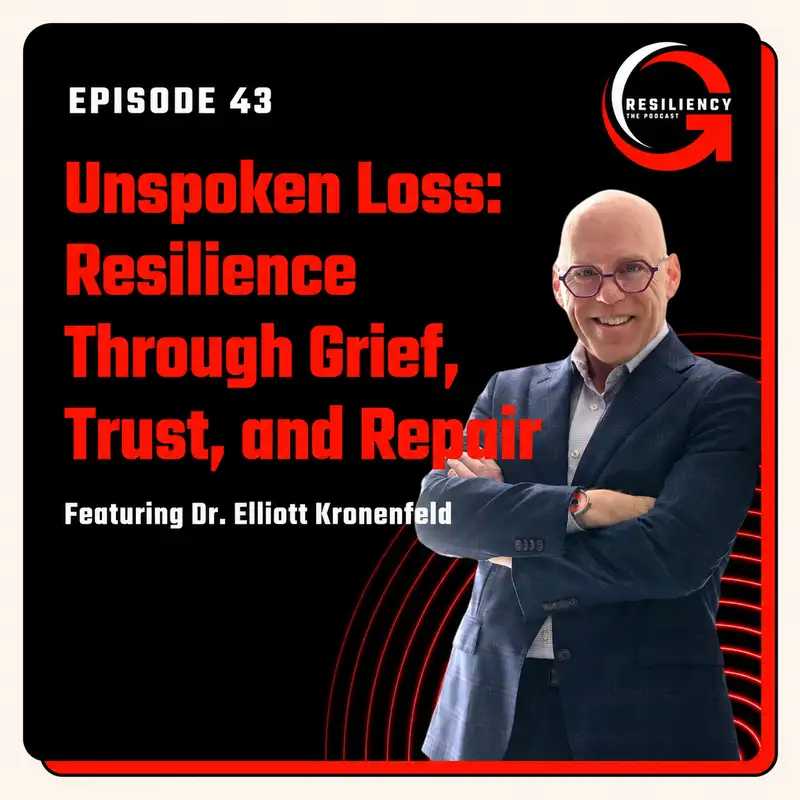
Unspoken Loss: Resilience Through Grief, Trust, and Repair ft. Dr. Elliott Kronenfeld
Jenn Quader (00:05)
Welcome to Resiliency, the podcast. Today we're exploring a kind of resilience that often lives in the shadows. It's the resilience required to navigate the deepest ruptures in our most intimate relationships. We're talking about the moments when identity shifts, when trust fractures, and when the story that we thought we were living in collapses beneath us.
Now this is something that many of us have been touched by in our lives. And today we're gonna talk about how individuals and couples can rebuild a foundation, not just of survival, but of intention, connection, and emotional truth. And we are gonna do that with the most amazing guest, you guys. he has work that sits at the intersection of relationship science, emotional healing, and personal transformation. Through his Couples by Intention framework,
He helps partners move from living reactively to living with purpose, with curiosity, clarity, and conscious choice. And through his latest book, which we will talk about, Unspoken Loss, he shares light on something really interesting, and that is disenfranchised grief. This is unspoken grief that often gets misread as anger or resistance or ambivalence, when in truth, it's heartbreak without a voice.
I'm sure you're going to see why this is just the perfect guest for our Resiliency the Podcast audience. He is a therapist, an author, an educator, and a guide for anyone who may be seeking to rebuild themselves and their relationships with intention. Please, we are honored to welcome Dr. Elliot Kronenfeld. welcome Dr. Kronenfeld.
Dr. Elliott Kronenfeld (01:40)
Thank you so much for having me. I'm so pleased that we're gonna have this really important conversation.
Kelly Culver (01:47)
Elliot, we're thrilled that you are a guest on our podcast because as Jenn said in her introduction, we're exploring an avenue that we don't typically go down. So I think that that's quite consequential. And I know that we will have a deep and thoughtful discussion. Generally, when we have our guests, we like to set the same frame for everybody. So we ask the same question at the outset. What does resilience mean to you?
Dr. Elliott Kronenfeld (02:14)
You know, it's such an important question in my work.
We use common language all the time. And I always ask people how they define words, because there are so many words that cause disconnect, because we think we're speaking the same language and we aren't. And resilience is one of those words that I have in recent months been adding to my list of words to define. So I'm so happy that this is where we start. For me, my definition of resilience is how we
we
remind ourselves that we have a choice, no matter how challenging things become, that if we're curious, we always have an option to be intentional in some way. And it's in that ability to remember that we get to make choice, no matter how large or how small, that allows us to create a sense of personal navigation.
Jenn Quader (03:13)
You know, I'm struck by this and I know we're going to talk a lot about choice and curiosity. but what I see in that is a need for, the word that comes to my mind is like detachment.
So, and I'm gonna speak from the woman's perspective, because I happen to be one. And so when we, you you're in a fight with your husband or you're doing something, often I can't get to that place of curiosity because there's a lot of emotion behind that. So I when you're defining resilience in such a beautiful way, which is that ability to get curious, to know you have a choice.
How does one approach something like what I'd call detachment? Is that how you would see it? How do you keep that roaring lion of emotions from ruining the resilience portion?
Dr. Elliott Kronenfeld (04:00)
Ooh, such a good question right off the top. I think that The the way that I define curiosity is that it's the opposite of assumptions.
If we're making assumptions, we're not being curious. If we're being curious, we're challenging our assumptions. And oftentimes it is the unvalidated assumptions that we make that are driving the emotional response. And if we could just take a breath, I always say breath is our foundation. If we take a breath, we take a beat, the mind calms just a little bit because we're bringing oxygen up to the brain.
then we can ask a question. When I'm working with couples, one of the things that I say most frequently is ask a question before you make a statement. And when couples are heightened, I'll look at one of the partners and I'll say, what question do you want to ask? So instead of reacting, we respond. And when we respond with a question, we're more likely to get more insight.
which then allows us to think through what our options are, bringing more resiliency.
Kelly Culver (05:15)
That's very interesting because you say, you know, rather than responding, asking a question, you know, the other thing that it requires people to do, and we're not very good at it when it's in the heat of the moment, it requires us to listen, to actually care about listening to the response to the question that you've told us to take a step back, breathe and ask. That's tough.
Jenn Quader (05:15)
Please, no.
Dr. Elliott Kronenfeld (05:38)
Yeah, when I start working with couples, I spend a lot of time working on listening skills before we start talking about all of the challenges in their relationship. Because nobody ever teaches us to listen, right? To your point, Kelly, right? Is that we're often told that listening as you look and you make these funny faces. Hmm. Right? That's how you know I'm paying attention. ⁓ But
When we're listening, we're talking as much as our partner is. We're vocalizing as much as our partner is when we're actively listening. Because I always say, when we're listening, well, we have two jobs to do at the same time. The first job is to bear witness. Because if you're telling me your story, you're telling me about your experience, your reaction, your thoughts.
then I should be listening from a you perspective and not a me perspective. Which means nothing you say has anything to do with me. And if you come to me and you tell me how angry you are with me, that's not about me. That's about the reaction you're having to something I did. And so if I am bearing witness, then if I don't go up into my head and start getting defensive,
and start justifying and start trying to clarify and start predicting, I've heard this before, I know exactly where this is going. And I stop strategizing, go ahead, take a breath, I dare you. Right, because I've got a response to that. Right, all the things we do up in our head means that we're not actually taking in, we're not actually receiving. I'm not actually bearing witness to what it is you want me to know.
And the second critical job that we have to do at the same time, as if this wasn't hard enough, is we have to expand the story. Because the reason why we have the same arguments, the same disconnects over and over and over again, is because we don't resolve them in the first place. I always talk about it like the mildew on the backsplash behind the kitchen sink. Right? If you take a paper towel and you wipe that away, that mildew is just gonna grow back. You gotta get in there with bleach and scrub that stuff out.
You gotta get to the root of it. And so is the truth with listening. And so if we're going to expand the story, I have to ask for more. Tell me more, tell me more, tell me more. Am I the only person that happens with, on a scale of one to 10, how intense was that? What made you feel like you had to hold that in the moment? There's no right questions, but I'm gonna ask a lot of questions. I wanna get all of the story.
And again, because I'm not making it about me, what I realize is that at the end, you're gonna say yes to the most critical question. And the most critical question is, do you feel seen, heard, and understood? And if I can get you to say yes to that, then both of our resiliencies go up.
Kelly Culver (08:47)
totally.
Jenn Quader (08:50)
Yeah, yes and wow and well first of all, I'd like you to please speak to anyone and everyone that I know and I hope everyone is listening and tuning in because this is such valuable information. I want to jump to something entertaining before I jump to my next question for you Dr. Kronenfeld because what you said really made me think about it. talked first of all, I love that we brought this to listening and I think it's interesting.
Kelly Culver (09:01)
Yes.
Dr. Elliott Kronenfeld (09:03)
Okay.
Jenn Quader (09:13)
put it through a leadership lens, that that's kind of the first skill that we started learning when we, I'm sending my whole team through leadership training and I'm doing it. so this mirrors a business audience, whether it's in your relationships or in your business, you need to have that. The second thing that was cracking me up as you talked about it, because you talked about, and it's so clear to me, this ability to, once we bear the witness, once we can truly get past that inner voice and we're really bearing witness, then we are asking those questions. ⁓
Dr. Elliott Kronenfeld (09:23)
Mm-hmm.
Jenn Quader (09:41)
being able to ask more, expand the story. And that reminded me of there's a comic who's on Saturday Night Live, Marcelo Hernandez, and he just put out a special. Did either of you see it yet? It's good and funny, guys. It's called An American Boy and it's very funny. But he's doing this bit and he's talking about how he's jealous of other men. And he says, yeah, he says, that dude, I bet that dude has follow-up questions. Because he's talking about how much women love follow-up questions.
Dr. Elliott Kronenfeld (09:52)
Not yet.
Yeah.
Jenn Quader (10:12)
⁓ So it's it's brilliant. What are your thoughts, Dr. Kronenfeld?
Dr. Elliott Kronenfeld (10:12)
Yes!
Well,
I love that you attached us back to leadership because that's exactly right, Jenn. You know, if you want to be a leader in your relationship, I always say the difference between a manager and a leader, a manager is trying to get a job done. A leader is trying to show people where True North is and how do we get there. And they're removing all of the roadblocks along the way so everyone can continue to move. So if I want to be a leader in this relationship,
I need to show you what true North looks like for me, and I need to remove the roadblocks that are going to get us there. And so you're right, it is exactly like leadership. If I'm gonna be a manager, I'm just gonna manage this situation, but we're not moving anywhere. I'm just managing this moment. And our relationship is so much bigger than this moment.
Jenn Quader (11:10)
I love it. I want to stay in this for just a minute because you've talked about things that I think are really applicable to any and every relationship. And as you said, whether it's within a team or within an intimate relationship, I think that this is all relative. This is all relevant as far as listening and expanding the story and the follow-up questions. I want to push more into your specialty, which has to do with these intimate relationships. And what I know is that you work with couples and individuals
And this goes beyond, let's say, just a healthy, happy marriage, which I know all of it is part of, but you're working with couples who are facing things like infidelity, things like infertility, like libido differences, which I'm from the South you don't even talk about that stuff, you know what I mean? So, libido differences, trauma, things like identity transition, so these are some really deep things. I wonder if I could ask you, it's kind of the same question. Dr. Kelly asked, what does resilience mean to you?
I'm gonna ask through the lens of couples who are navigating those types of challenges, when you look at those experiences, how would you define resilience within an intimate relationship?
Dr. Elliott Kronenfeld (12:18)
Well, because what happens is an interesting question because then it's two people defining it. And when I'm working with a couple, tell people, I tell partner one, you are not my client. And I tell partner two, you are not my client. My client is your connection. My client is your relationship. It's that space that's on the couch between the two of you. Now, depending on why they're coming to see me, right?
For example, if they're coming in because of infertility, it's about how can I close that gap between the two of them? If they're coming in because of infidelity, it's a completely different process. So the process works differently based on the challenge in front of them. In infidelity, what I tell them is infidelity comes from the word fidelity, which means trust.
And so an infidelity is anything that breaks the trust. It doesn't just have to be sexual or romantic or emotional. If one partner takes all the money out of the savings account and goes to the casino and gambles it away, that is an infidelity. If one partner is telling the secrets of that marriage or of that partner to a third party, a best friend, their hairdresser, that is also an infidelity. So it's anything that breaks the trust.
You know, we have a very narrow definition often in common society of what is infidelity and who is right and who is wrong and who is good and who is bad. And so when infidelity happens and that trust is broken to the point where real disconnect happens, and through the lens of resiliency, I usually start off with saying something incredibly painful and shocking.
I will look at them in the very first session and I will say, let me be honest with you. This marriage is over.
It's over. But there's a more important question on the table in front of us. Will your next relationship be with the person who's sitting on the couch with you today? Because the truth of the matter is we can spend an awful lot of time going back throughout whatever years you've had in this relationship, poking at all of the pain, all of the missteps that both of you have taken to lead to this moment.
maybe one of you more than others, but both of you have participated because it has been a dynamic. Dynamic comes from the word di which means two. So both of you have been involved in the creation of this dynamic. Now we can spend all the time going back and poking in all the holes of all the pain, or you can make a decision and be curious about what could be and what needs to happen if we were to go there. It's going to be a lot of work.
We have to rebuild trust. We have to reset parameters. We have to renegotiate boundaries. We have to learn new ways to communicate, new ways to listen. But the question in front of you is what is the first step you're going to take? If it's forward with the person on the couch with you, we are going to build something new because clearly the old one wasn't working. We're not going to go back and try to fix the broken one. We're going to build something new and different.
Kelly Culver (15:44)
I like that. I like the fact that you're talking about not going back and fixing the thing that is broken because inherently, in the way that we talk about resilience, there's an element of bouncing back, which doesn't mean fixing the broken thing. It just means recovering the things that were good.
is an element of adapting to the situation in which you find yourself. So that thing's broken. We need to look at it through a new way. And ultimately when you're looking at it through a new way, you're transforming it to something completely different. I don't think couples, now this is just my opinion, I don't think couples actually have the courage to address the situation that you're talking about in precisely the way that you have. I think it's really phenomenal to say, that's then, that's broken, let that go, it's irrelevant
What you have is the now and the forward. That's really powerful.
Dr. Elliott Kronenfeld (16:41)
Well, and that's, think, where resilience is. We have to address what's going on now. And when we're traumatized by an infidelity or even infertility or any of these other real challenging couple dynamics, if we're behind us all the time, we're not moving forward. We're anchoring ourselves to the history.
Kelly Culver (16:44)
Mmm.
Yeah.
Jenn Quader (17:01)
You know, it's making me think I'm gonna draw one parallel to the team stuff and the business stuff again. my client is not you, person A, or you, person B. My client is the connection between you. And then when you say something as shocking as like, this marriage is over, we're gonna start something new. What strikes me is
We talk about kind of three buckets of skills in business. There are the technical skills, can you do the job? There are the personality skills, can you lead, can you effectively move people? And then there are the commitment skills. And it seems to me this is what you're asking them in the beginning is are you committed to this? Are you committed to trying something new, to reintroducing oneself and almost creating a whole new way of living around this because we have to let it go?
in order for the future to exist in a positive way.
Dr. Elliott Kronenfeld (17:52)
I think that's exactly right. I think that's exactly right. And I think that commitment skills is the key here. And I know we're gonna talk about disenfranchised grief and some of those other parts, but.
That's the core of it, right? What's stopping you from being committed, even though the work is hard, even though the work is painful? When we're in business, right? If you're doing mergers and acquisitions, you're doing all of, by the way, I used to work in organizational development and behavior before I became a therapist, you're talking my language, right? So if you're doing M &A or you're doing leadership talent recruitment, it's all the same thing.
Jenn Quader (18:24)
Yeah, I love it.
Dr. Elliott Kronenfeld (18:33)
What is allowing somebody to do the thing that is hard? And does the perceived value outweigh the fear of what is challenging? Like there's a math equation in here.
Kelly Culver (18:48)
but there also is a very brutal reality. If we talk about M&A, let's talk about that for a minute. Sometimes the very best decision is an exit. It is an exit strategy. So it isn't a commitment to creating something new with this person sitting on the couch beside me. Sometimes the very best thing to do for oneself.
Dr. Elliott Kronenfeld (18:57)
Yes? Absolutely.
Kelly Culver (19:06)
is an exit strategy. And you have to help them be fearless in being able to come to that realization because they need to move on with their life.
Dr. Elliott Kronenfeld (19:14)
I think you're
exactly correct. The question is, is that decision to exit a reactionary decision or have you done your work as an individual to look at
where all of your options are and what is the value proposition for staying versus leaving. And so often when there has been a relationship fracture, there has been a knee jerk reaction to leave, or if there's a grounding sense that I should stay, having to face the social pressure that you should leave.
Because that decision is not just internal. Because once people understand that your relationship has been fractured, if that becomes public in any way, everybody jumps in. Everybody has an opinion. It's like a shark feeding frenzy.
Because if you decide to leave, there's this really weird social dynamic where you not only lose your relationship, you start to lose huge parts of your social structure, social support, because people are afraid they're going to catch divorce.
Right. And there starts to be this isolation. This is a weird social dynamics around it. Or if you decide to stay or leave in a way that doesn't honor the advice I'm giving you, then even if you end up doing the behavior that I think you should do, I still cut bait because somehow or another, I am the expert on you and your relationship. And so the two people in the relationship or three of it or more, who was in that relationship dynamic,
Kelly Culver (20:30)
Mm-hmm.
Dr. Elliott Kronenfeld (20:55)
are challenged in deciding for themselves what is the right path forward for me because I have the pressure from my relationship partner, I have the pressure from the people outside of the relationship or children if we have them and being able to quiet the noise to be able to say how do I choose it all everything comes back to choice right how do I choose in a very intentional way
whether to stay or whether to go.
Jenn Quader (21:26)
all of this is really interesting. And I think this is kind of a nice segue into you mentioned disenfranchised grief, but I want to take us there a different way because of what you talked about. You were talking about the perceived value and Dr. Kelly brought in the astute idea that when you're in M &A, sometimes you have to walk away from that.
And to your point, you only walk away after you have assessed the value. Will this bring value to me later on? What I'm interested in, and you also talked about the social dynamic, which I hadn't thought about, but as you say it, I can feel it around me. Like, of course, as this begins, your mom says, you got to leave him. You know, then your sister says, you got to leave him. And then your friends aren't your friends anymore, and this all falls apart. What I want to ask about is, you're looking at the perceived value of the relationship.
which is the patient you, Dr. Kronenfeld is treating. When I'm person A or person B, what about the perceived value of myself?
Dr. Elliott Kronenfeld (22:22)
Yes, but that's not my work to do, that's your work to do. And I can help you to facilitate that, I can help your partner to facilitate that. And the process of healing broken trust is about what have we learned and how do we show up? And it's not just, I trust you again?
Right? Because there are these stages. What do I want for myself in the sense of who do I want to be as a person of the world? Who do I want to be in a relationship? Who do I want to be in terms of whether I feel like I'm living my values and honoring my scripts or my living according to the way other people think I should live? Right? There's a lot of meat on the bone there that we need to break down.
And what I tell people, especially from a resiliency perspective, that defining words is really important, as we said in the beginning, three of the words that I define very early on are forgiveness, trust, and security. Because we often will lump those together into one kind of emotional visceral somatic dynamic, but they're actually very different things.
always say forgiveness is an awareness. Forgiveness is the awareness I have of what has happened. And when I stop pretending that it didn't or wishing that it didn't, and I actually accept the reality in that this is my reality. It doesn't mean that I condone. It doesn't mean that I'm not angry. It doesn't mean anything other than.
This is my story and I've stopped fighting against it. Now, forgiveness grows from there, but that is really the start of forgiveness. So that is an awareness. Trust is a decision.
I trust you until you give me a reason not to. Or I trust you once you've proven yourself. Either way, it's a decision. And when I work with couples in conflict, I say to them, trust is not binary. It's not trust or not trust. There are lots of ways you trust each other. I trust you to bring home a paycheck. I trust you to pick up the kids. I trust you to mow the lawn on Saturdays. I trust you to bring home the groceries. I trust you to pay the bills on time.
I don't trust you with your social media. I don't trust you with your phone. I don't trust you when you go away overnight. I don't trust you when you are clamming up and not talking to me. But trust is a decision and it's a spectrum. And so what I do with couples, I'm like, so where is their trust and where does trust need to be reestablished? Because you and I are not solving the same problem.
The hurt I have in this relationship and the hurt you have in this relationship based on the roles we have played are not the same. I don't trust you to contain your feelings and to share them with me in a way that doesn't lash out and hurt me.
Right? I don't trust you'll tell me the truth. So we work back and forth about how do we reestablish what will allow me to make a decision to trust in the next iteration. So now we have an awareness and we have a decision. Security is a feeling. And it's a simple equation. Consistency plus time equals security.
I need to see certain consistent behaviors, reactions, attitudes, emotions over time before I can feel secure with them. You can't do it once and think everything is good. Depending on the depth of the fracture and the depth of the hurt, the more consistent over time you're going to have to be. So we have an awareness, we have a decision, we have a feeling. They're very different things.
And all of that together when we're working on it starts to strengthen relational resiliency.
Kelly Culver (26:40)
When you're talking about this concept of trust, I trust you to pick the kids up, but I don't trust you with social media or these kinds of things. That brings then in an element of a lot of conditions.
Dr. Elliott Kronenfeld (26:56)
Yes?
Kelly Culver (26:56)
That's a challenge, right? Because my trust is conditional on these things. And that conditional trust, if I don't feel the conditional trust, I know I cannot get to that place where I am secure or I am stable.
Dr. Elliott Kronenfeld (27:14)
Correct. All trust is conditional.
Kelly Culver (27:18)
I would argue that it's not, but let's not have that discussion.
Dr. Elliott Kronenfeld (27:22)
Yeah,
no, well, let me just say why I say that. No, but let me tell you why I say that, especially in intimate partner relationships, because trust isn't monolithic. Because in our relationships, as we grow and as we evolve, we are constantly changing. Listen, I can have this really beautiful connected dynamic relationship.
Jenn Quader (27:23)
Let's do please, I love it.
Dr. Elliott Kronenfeld (27:48)
And as we grow, as we age, as our bodies start to age, as our bodies function differently, as our emotional needs change, as we go through the different stages of life, we are constantly unpacking and exploring things that may be really scary for me. And I have to think about how I'm gonna bring that to you. Even in the healthiest of relationships, partners are cautious.
about bringing challenging things to the forefront. Because trust is conditional. I'm not saying it's problematic, but we have to test the trust. What happens when I say to you, my libido is waning? I actually don't want to have sex as much as you do anymore. Or I don't want to have sex in that way anymore. Or I want to introduce a new way to have sex that I'm afraid you may say no to. Right? Trust is conditional.
I'm not saying I don't think that's problematic. I think that's realistic. And it's our ability to lean into that unknown, unverified decision to trust because I haven't gotten back feedback to know I can do that. It's constantly changing.
Kelly Culver (29:07)
I would posit that there's an element of belief that we attain as we mature and experience a lot of different things. And once you believe fundamentally in someone, trust becomes less conditional. It doesn't need to be conditional.
Dr. Elliott Kronenfeld (29:26)
I would hope that also requires
too and we're not always at the same place.
Kelly Culver (29:31)
Yeah, true enough, true enough, true enough. Well, let me ask you a different question, sort of in the same line, because this is talking about or not talking about how we feel and what we process and experiences that we've had in the past. And you talk quite a bit about disenfranchised grief.
Dr. Elliott Kronenfeld (29:33)
Right.
Kelly Culver (29:53)
I want to use a different word than disenfranchise, so let's just speak real plain language for our audience, because some people might not understand what that means, so you can explain what that means. But what I'm really curious about, and Jenn talked about this in the introduction, is the concept of shadow losses.
really can you talk to us a bit about shadow losses like what you've just been taking us through around identity or shame or grief that we haven't been allowed to process or we don't believe we've been allowed to process and how that maybe inhibits our way of being able to move forward. Talk to us about the shadows because a lot of people live in the shadows and we could learn a lot from you.
Dr. Elliott Kronenfeld (30:37)
Yeah, I do want to take a quick second and talk about the word disenfranchised and how it's used. disenfranchised grief is the grief that I cannot speak or believe that I cannot speak about or I'm not allowed to feel because it is unsupported. And so, for example,
my mother passes away, I assume people will say, my God, Elliot, I feel so bad. I'm so sorry for your loss. And they'll bring me a casserole, right? ⁓ But if I cheat on my partner,
Right? And I can't go to my partner and say, I am so sorry for what I did. It was terrible. I regret it so much. I really want to be with you. I want to heal this injury. I love you. I want you to learn to trust me again. And I grieve the loss of my affair partner because that person meant something to me. I'm glad they're gone, but I grieve them.
I can't say that because what would people think about me? Or I can't say, I'm so glad the affair is over and so many people come in and like, I'm so glad it's over. I felt so trapped by it, I couldn't get out of it. And it took discovery and this fracture for me to get out of it and I'm so glad it's over. But I miss how I felt at the height of it.
because I felt powerful and I felt desired and I felt sexy in a way I haven't felt in years and I could feel there was a freedom in being able to go after what I really wanted. I can't say that, that I miss having that feeling. in terms of shadow losses that emanate from that kind of disenfranchised grief, know, part of it is, so let's say I have an affair.
I can never again say, I'm the man who never cheated on my partner. I can never say that. I can never again say, I was the role model for my children that I always said I would be. I can't, I've lost that identity. I can, and when this becomes public, I lose my...
social standing, I lose my credibility. Because every time we go to a dinner party, I know they're thinking, you know what Elliot did, right? Even if they're not saying it, that sense of security and being in public that I can walk into that social environment with credibility, with reputation, with standing, because I can't do that anymore. Or when I walk into my in-laws house for Thanksgiving,
And they say, can you pass the gravy to the cheater? Right, now they may not use that word, but what am I feeling? Right, so it's that loss of standing, that loss of, and I've worked with so many people where their losses have become incredibly public. Where I had one man who was a deacon in a church and he lost his deaconship.
Jenn Quader (33:44)
Yeah.
Dr. Elliott Kronenfeld (34:00)
because his infidelity became known. I had one man who worked at a car dealership and his wife burned every bridge and he lost his job. And he couldn't get another job because it was a small town everybody knew. But disenfranchised grief, this kind of shadow loss happens outside of infidelity as well. When we have parents who have lost their children to the system.
because they can no longer be good parents. And they say, you know, I miss my children. I grieve the loss of my children. And people say, you should have been a better parent. Well, if you had done your job, you wouldn't have lost your children. Or when we have senses of loss for folks that are going through infertility.
And they actually have the courage, because infertility is still one of the things we can't talk about today, right? Unless it's after the fact. But when we're going through it, people don't want to talk about that. And they start sharing their grief around infertility. And people say things, well, you can always just adopt. Or drink the tea, or go pray. they say really painful things like, ugh, listen, I have kids. Enjoy your time without them while you can.
and their pain, their grief is not allowed to be spoken because people can't tolerate it. And so some of the shadow losses are very direct, like I can't go to Thanksgiving or I can't, I lose parts of my identity or...
Three weeks ago when I had a woman come into my office and raged because her manager at work who knows she's going through IVF treatments, tasked her with planning the baby shower for her coworker.
This is disenfranchised grief. These are the shadow losses. These are the pain points. And by the way, in infidelity, I want to be really clear. We talked about the person who caused the betrayal. The betrayed partner also has disenfranchised grief. When that partner goes and says to their best friends, my God, this happened to me, and they say, you throw that dog to the curb. And they say, actually, we're going to work it out.
I believe in this relationship and they're like, well, you made your bed, you lie in it then. Then don't come crying to me when it happens again.
and their network starts to pull away from them because they actually believe this relationship is important for them. It happens in so many ways.
Jenn Quader (36:48)
Well, I'm glad you defined it. If anyone is watching the video, they might have seen me burst into tears in the middle of that. So I feel like I should address it.
I'm seeing what you're saying in a lot of ways, but I'll start with this. I personally experienced infertility and I personally experienced later on in life being told by someone I love a lot. And it's very true, me saying, I didn't get to have kids and them saying, well, you could have had kids, you could have adopted. And me acknowledging that's true. And so I think from a personal standpoint and forgive me for the emotion in my voice, but I understand now.
Much more than when I read your introduction, Dr. Kronenfeld. I understand now really what you mean about grief that can't be spoken, because it's not that I can't share that experience with people, but it's very difficult. I'd like to move beyond me, although feel free to ask any questions. But beyond me, I would say what I see in that when you talk about the infidelity and the other thing, infertility and libido and those things often are not a choice.
Infidelity tends to be, and what came to my mind when you talked about early on the grieving, the loss of the affair partner and I'm missing how I felt, the word clandestine came to mind. I just chatted with a friend of mine about that and how clandestine activities or those that are racy, those that are outside, they can be so addictive and you want them. And so it is interesting to me
often what you're missing is kind of the danger of it. And then once you're caught, you're having to handle those griefs. So I'm giving you two buckets, is, wow, I understand disenfranchised grief a little more. Thank you for that expression. But then also, there is a push and pull between wanting to do the negative and enjoy the negative and then having that grief afterwards. Thoughts?
Dr. Elliott Kronenfeld (38:41)
Yeah, I think all of that is true, right? And one of the scandalous things that I often say to couples is if you're looking for that clandestine, like behind closed doors, kind of sexy behaviors, I think you should have it. I think you should have an affair with your partner. What if you were to treat your partner like an affair partner?
What if you were to say to your partner, don't tell anyone but I got a hotel room. Listen, show up after work, don't wear any underwear.
Right? Like, the point is we forget that when we started this relationship, all this stuff was there. But what happens is we get into long term relationships, we make this commitment to be in the relationship, and so many couples think, well, that's the last time I had to make a choice. Everything just went on autopilot from there. The truth is, if we're going to be intentional, let's talk about the definition of intention.
Jenn Quader (39:23)
It gets racy, you're right. You're absolutely right. Even, yeah.
Dr. Elliott Kronenfeld (39:49)
It means to make choice. To be intentional means that I have to know what all of my options are. I have to place a value on each of those options and rank order them in some way and then choose one. And then I have to act on it, right? Now, I'm an incredible coffee snob, right? I can go into any coffee shop in the world and order the bougiest coffee drink on the turn of a dime and change it based on my mood. I'm that guy, right?
And I can be really intentional that quickly. But there are some times when being intentional can't be that fast. Do I want to move to another state? Do I want to take this new job? Do I want to have a baby with you? Do I want to marry you? Do I want to forgive you? Right? Do I want to lean in on the trust question?
I have to be really, really intentional and make those choices. And so what happens in long-term relationships, we forget to be intentional. See, here's the truth of the matter. I'm in this really wonderful long-term marriage. We've got two kids. One of the things that I love about my marriage is I am constantly
looking for really creative ways every day to let my husband know that I choose him. And sometimes it's because I actively tell him or I send him a funny meme or I go to the grocery store and I bring him home a special treat or I plan something for us or I...
tell the kids they can't come home because our kids are older. No, you can't come home this weekend. We're having a parents weekend, right? I try to find these really wonderful ways to let my husband know that I choose him every day. And what I get in return is I need to feel chosen every day. And my husband, who is an incredible baker, every day he'll send me a text picture of something he baked because he knows I like it. And he's like, these are on the counter.
Next thing I know, something will show up, a package delivery will show up at my office that I didn't know was coming. Or, you know, quite frankly, he supports my mother whether he wants to or not.
Jenn Quader (42:08)
He deserves a trophy. deserves, I mean, what does he need? He wins.
Kelly Culver (42:08)
He's a saint. yeah, you got to be doing more for him.
Dr. Elliott Kronenfeld (42:15)
he's a trophy
husband. Listen, I am married to a trophy husband. I'm married up. I'm clear.
Jenn Quader (42:20)
Yeah!
But you know, it strikes me, first of all, I love, like just love this vision of the two of you and the love. And it also strikes me as, there was something I read at some point and I'm sure, you know, what I have found in my marriage is in the way I say it to people is like, you know, some years you hate your spouse and some years you love your spouse and you always love your spouse. But there are some years where your spouse gets more on your nerves or, you know, those things.
And as it relates to you and your spouse really choosing and giving yourself that love every day, one of the things I read at the time where there was a time where we were more, let's say at each other's throats, was anything you're thinking in your head, like if you're thinking he's being selfish, you're being selfish. Like it was something about like whatever you're thinking about him, your behavior is likely mirroring whatever you're thinking. And I started to see that, like when I would think he was selfish, it would make me be selfish.
Dr. Elliott Kronenfeld (43:18)
Yeah, well, retaliatory, right? Retaliatory emotions. My grandmother, Annie, was the most brilliant woman that ever walked the face of the earth. She truly was. And my grandfather died young. My father was still a young boy, so I never met him. But my grandmother, who lived into her mid-90s, was married to that man till her last breath.
And she was such a font of wisdom. I remember when she was like in her late 80s, I asked her, I said, know, this marriage that to this man who I never met, who I feel like I have this deep relationship with who died before I was even a thought, how did you make this marriage work? And she said to me, you know, I decided early on.
there were two things that my husband could do that I promised I would never get mad at. And if he did one of those two things, he would get a pass, I would calm down, we would talk about it, and we would get through it. I said, okay, what were those two things? And she looked at me dead in the eye and she said, anything he did.
Kelly Culver (44:36)
Ha!
bless her.
Dr. Elliott Kronenfeld (44:44)
That's resiliency.
Jenn Quader (44:47)
Resiliency. ⁓ wow. May she teach us all.
Kelly Culver (44:53)
That's right.
Jenn Quader (44:56)
So, ⁓ well on that note, again, I think we can all learn from her. And I wanna say this, we're gonna move into one of our favorite parts of the podcast, which is our rapid fire questions. But I wanna just mention for our listeners that Dr. Kronenfeld does have a book out called, Unspoken Loss.
men infidelity and disenfranchised grief. And it does tap into a lot of these things we have talked about. so, and Dr. Kronenfeld, I am going to ask you one more question before we get into rapid fires,
We've talked a lot about what people say about defining things about commitment. And I just want to quickly ask you, you also connect yoga and retreats and those types of practices to your work. And you talk a lot about central nervous system regulation. So I'm just wondering if you could speak for a moment to how this plays into that relationship before we then dive into rapid questions. I want you to have a moment to speak to the physical actionable strategies that some of our listeners might be able to borrow from this episode.
Dr. Elliott Kronenfeld (45:34)
Yes.
Sure, and I'll do this really quickly because we could do a whole episode just on that, right? So the vagus nerve that you introduced in the beginning, which is really part of
the amygdala in our brain, that monkey brain, the fight, flight, freeze, or fawn responses. I do own a yoga retreat company called Global Sangha where I take people all over the world to do relationship work in really great fun places. And we do meditation, we do yoga, we do cultural immersion, we do all these things. And the whole reason why we do this is because what I'm doing yoga, with meditation, is I'm tapping into that sympathetic
and parasympathetic nervous system. Because when we can control that, when we are mindful of that, we're more Then everything is better. Our thinking is better, our reactions are better, sex is better, our health is better. And I do a lot of yoga with my clients here in my office. Everything from pranayama breath work to restorative or even some yoga postures that I think really get them to feel in their body.
And the mantra that I often use with people is, breath is our foundation. Everything starts with breath.
Our ability to breathe in fully and exhale fully connects us to our body. We oxygenate our brain because when we're not breathing, and oftentimes when we're stressed, we're holding our breath, or when we're discontented, when we're fighting, when we're dysregulated, we're actually not breathing. We're having very shallow breaths, which means we're not oxygenating our blood. We're not getting oxygen to our brain. Our brain goes into a panic state, and then we breathe even more shallow.
And it's this terrible language which brings us to a panic attack, right? Right? And so breath is the foundation. So if you do anything, close your eyes, take a deep, deep breath into your belly, hold it for the count of two, and allow your exhale to be longer than your inhale.
Jenn Quader (48:05)
And on that, I just did it and it feels wonderful. And we will transition over to the best part of our show, which is Dr. Kelly, take it away on rapid fire questions.
Kelly Culver (48:13)
Oh, no,
no, this is not the best part of our show. Grandma was the best part of our show. Absolutely nothing's going to top that. She's the rock star today. However, to end keeping with that lighted more light humored. Elliot, what is your favorite movie or TV show that makes you feel resilient?
Dr. Elliott Kronenfeld (48:17)
Yeah.
Jenn Quader (48:23)
Relationship queen, that is grandma.
Dr. Elliott Kronenfeld (48:36)
So I'm addicted to quality reality TV, Survivor, Big Brother, Amazing Race. I wanna be on all of them. I wanna be on all of them. And I just found Traitors and I so wanna go on Traitors, just so I can be in a castle with Alan Cumming.
Jenn Quader (48:55)
Can I please go with you? Thank you. Okay, excellent.
Dr. Elliott Kronenfeld (48:56)
Yes, come.
Kelly Culver (48:58)
I've been watching that. I've
been watching that here in the UK. So cool. I know. Okay, what about a song that makes you feel resilient?
Dr. Elliott Kronenfeld (49:06)
You know, I have such an eclectic taste in music. I can do everything from Patsy Cline to John Denver to 80s pop rock. I love 80s Euro music. It could be anything.
God, I love Pet Shop Boys. Let's put it there, Pet Shop Boys.
Kelly Culver (49:25)
Okay, okay, so I'm thinking the opening ceremony of the London Olympics when they had the pet shop voice. was so great, remember? Yes. Okay, so what's the last thing that made you laugh out loud? Like really laugh out loud.
Jenn Quader (49:25)
job boys.
Dr. Elliott Kronenfeld (49:31)
Yes. Yes. Yes.
This ⁓ conversation tickles me so much. Or outside of this conversation, my daughter who is at Tufts University sent me ⁓ a picture of something she bought me, a manipulative foam squeezy thing from my office. And it's a rainbow whale. And it's a homosexuwhale.
Kelly Culver (49:46)
Awesome!
Jenn Quader (50:09)
Yeah! Homosexuwhale!
Kelly Culver (50:10)
my god.
⁓ my god. ⁓
Dr. Elliott Kronenfeld (50:15)
And she goes, I bought this for your office.
Jenn Quader (50:20)
office needs a homosexuwhale. That is fabulous. Thank you for sharing.
Kelly Culver (50:24)
you gotta find the link for that and put it in the description box. We've gotta do this. That's too funny. Okay, so let me get slightly serious. Do you have a question that you would like to leave for a future guest?
Dr. Elliott Kronenfeld (50:28)
Okay.
Jenn Quader (50:28)
need it. I have lots of gifts to buy. That's fabulous. That's fabulous. ⁓
Dr. Elliott Kronenfeld (50:30)
If
Yeah, you know, I think that it was kind of threaded through this conversation that becomes really important. I oftentimes when we talk about resiliency, it's very much an internal, very personal experience. But when is resiliency a group effort? When is resiliency
a shared experience, like between parent and child, between partners, between a team, that resiliency is often thought of as personal and individuated, but not always.
Jenn Quader (51:20)
Great question. And I now have one for you that was left by a past Resiliency the Podcast guest. So here we go. The question is, how do you intentionally lean into presence and awareness in everyday moments so that resilience becomes something normal and not reserved for hardship?
Dr. Elliott Kronenfeld (51:39)
I love this, this is a very active process for me. Breath is our foundation. I breathe intentionally, deeply, all day, every day, and yoga. Yoga saves lives. just, you know, as a registered yoga teacher, and yoga isn't just what we do on our mats. For people who don't understand yoga, the asana practice on our mat is just one small part of what yoga actually is. It's not exercise, it's not turning yourself into a pretzel.
The real meaning of yoga is how to calm the fluctuations of the brain. That's what yoga is. How do we calm the brain? And breath is the foundation.
Jenn Quader (52:21)
Absolutely beautiful. Dr. Kronenfeld, you have given us so much just true deep, deep valuable insights and information. For our listeners, it is Dr. Elliot Kronenfeld. And would you please let us know, where can our listeners find you if they'd like to follow you, if they'd like to get your book, if they'd like to learn more from this wonderful work that you're doing or attend one of your yoga retreats?
Dr. Elliott Kronenfeld (52:42)
Fantastic. So you can follow on all social media platforms under Global Sangha, S-A-N-G-H-A, Global Sangha. That's for all of the wellness, the mindfulness, the breathing as a foundation, and travel to really fun places. The books, Unspoken Loss and Couples by Intention, the book that came before that, can be found at sdppublishing.com or
online at Amazon or Barnes and Noble or quality book sellers near you.
Jenn Quader (53:18)
Fantastic. And listeners, we will have all of that in the show notes. We hope you will tune in. Dr. Kronenfeld, thank you for joining us and for all of you out there.
Thank you for being with us. resiliency is something you're interested in, we ask you to like this episode, subscribe to our YouTube channel and keep tuning in. We are here to bring resilient stories forward into your life. You can find us on social media, on all of the social channels or at resiliencythepodcast.com. This is the place to find stories, strategies and inspiration on how to embrace change.
overcome challenges and redefine resilience in our ever-changing world. I'm Jenn Quader You can find me online, J-E-N-N-Q-U-A-D-E-R on all the socials or my company, The Smart Agency, and our brilliant, amazing co-host, who I love dearly, Dr. Kelly Culver. You can find her at culvergroup.ca. That is C-A for Canada.
the very best country there is. And then you can also find her on Instagram and LinkedIn under Dr. Kelly Culver. Ladies and gentlemen, we wish you happiness and success and resilience in all of your relationships. And until we see you next time, take good care, be resilient, and breathe. It is the foundation. Thank you.
Creators and Guests